AI, Alchemy and Strategy.
For a long time, the technologists who built AI have deserved the attention. So too, perhaps more accurately, have the investors who funded them, often drawn from industries that were themselves built on extracting value from earlier digital platforms. That helps explain why so many people still expect AI to be more of the same: another wave of digitisation, another layer of automation, another engine for scale. But that is not quite what is happening.
The internet stored the world in digital form. It hoovered up text, images, audio, and video, turning what had once been fixed in paper, film, tape, or canvas into data that could be copied, searched, and moved around at almost no cost. AI does something different. It ingests that world and works less with the originals than with the relations, structures, and latent possibilities they imply. It is interested not just in content but in pattern, geometry, and recombination.
That matters because it changes the nature of modelling. In the past, much of knowledge work involved taking a favoured model and trying to adapt it to a specific problem. The work lay in selecting the framework, translating the situation into its language, and then trying to make the fit good enough to be useful. Now the sequence can be reversed. Instead of forcing the problem into an inherited model, AI allows the rapid construction of a model for the problem itself.
Models in conversation
That is where the change becomes practical. AI has seen enough examples, patterns, and structures to help create provisional models that are tailored to a particular issue, a particular context, and a particular moment. It can mix and match intellectual approaches, surface analogies, generate tensions between perspectives, and create a working frame far more quickly than most people could do unaided.
The most useful way to think about this is not as asking AI for an answer, but as asking it to stage a conversation. A proposition can be put before it and tested through a virtual panel of agreeing voices, dissenting voices, and voices from outside the frame. The result is not truth delivered from a machine, but structured friction: a fast way of exposing assumptions, alternative readings, blind spots, and possible reframings. What matters is not whether the machine is “right” in some final sense, but whether the exchange moves understanding forward.
This is where AI becomes strategically interesting. It does the donkey work around judgment without relieving human beings of the need to judge. It can generate options, map objections, explore adjacent frames, and create temporary artefacts in real time. Some of those artefacts may be visually polished enough that, in an earlier era, they would have become outputs to circulate, defend, and preserve. Now they can be used and discarded within the same morning if they have served their purpose.
The cadence of OODA
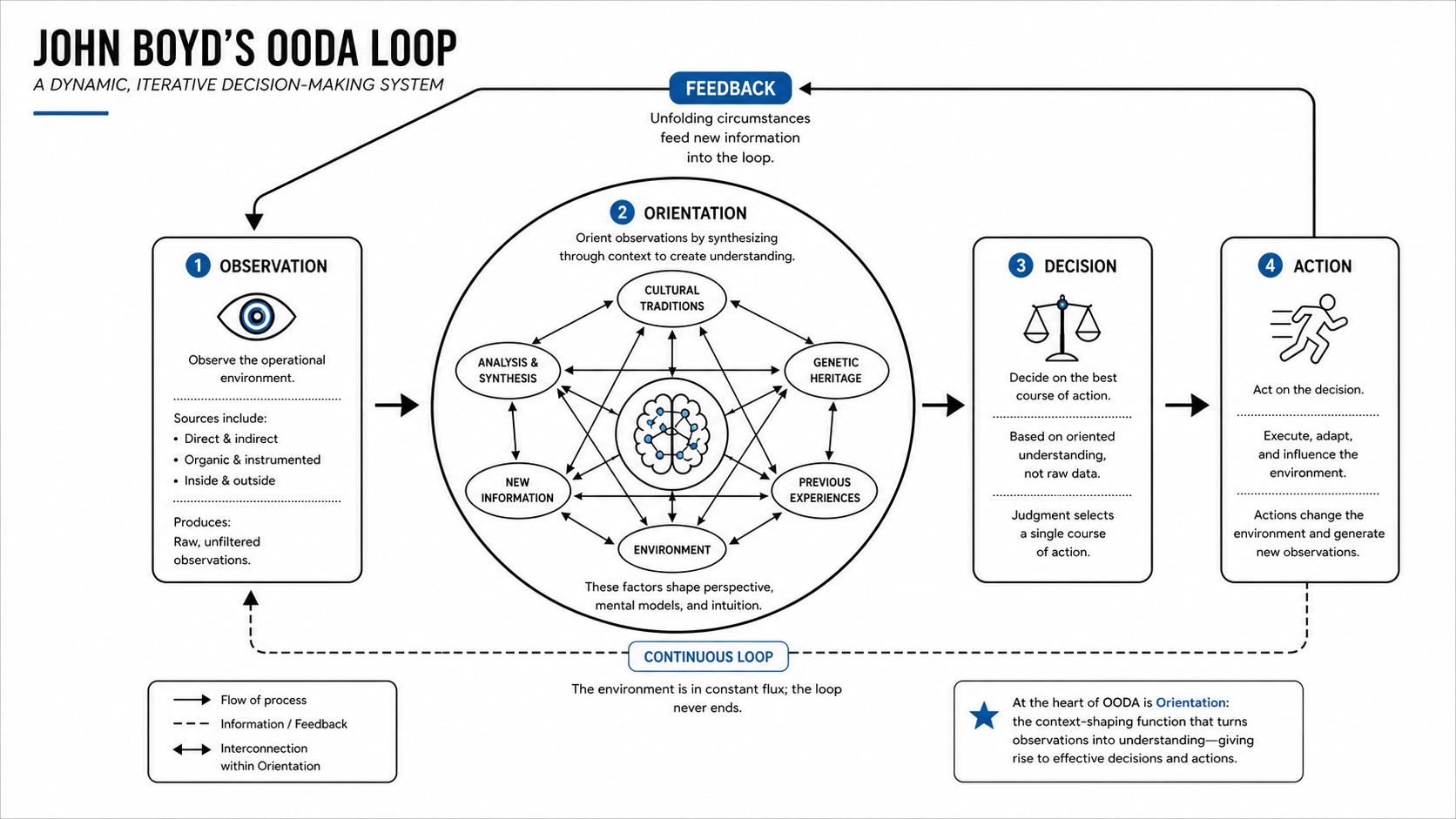
This is also why the language of speed can be misleading. The tempting claim is that AI simply speeds up the OODA loop. But that is only partially true, and in some ways it misses the more important point. Boyd’s fuller model was never just a neat circle of Observe, Orient, Decide, Act. It was a far more complex, recursive architecture in which orientation sits at the centre, continuously shaped by analysis, synthesis, previous experience, cultural traditions, new information, and feedback from action.
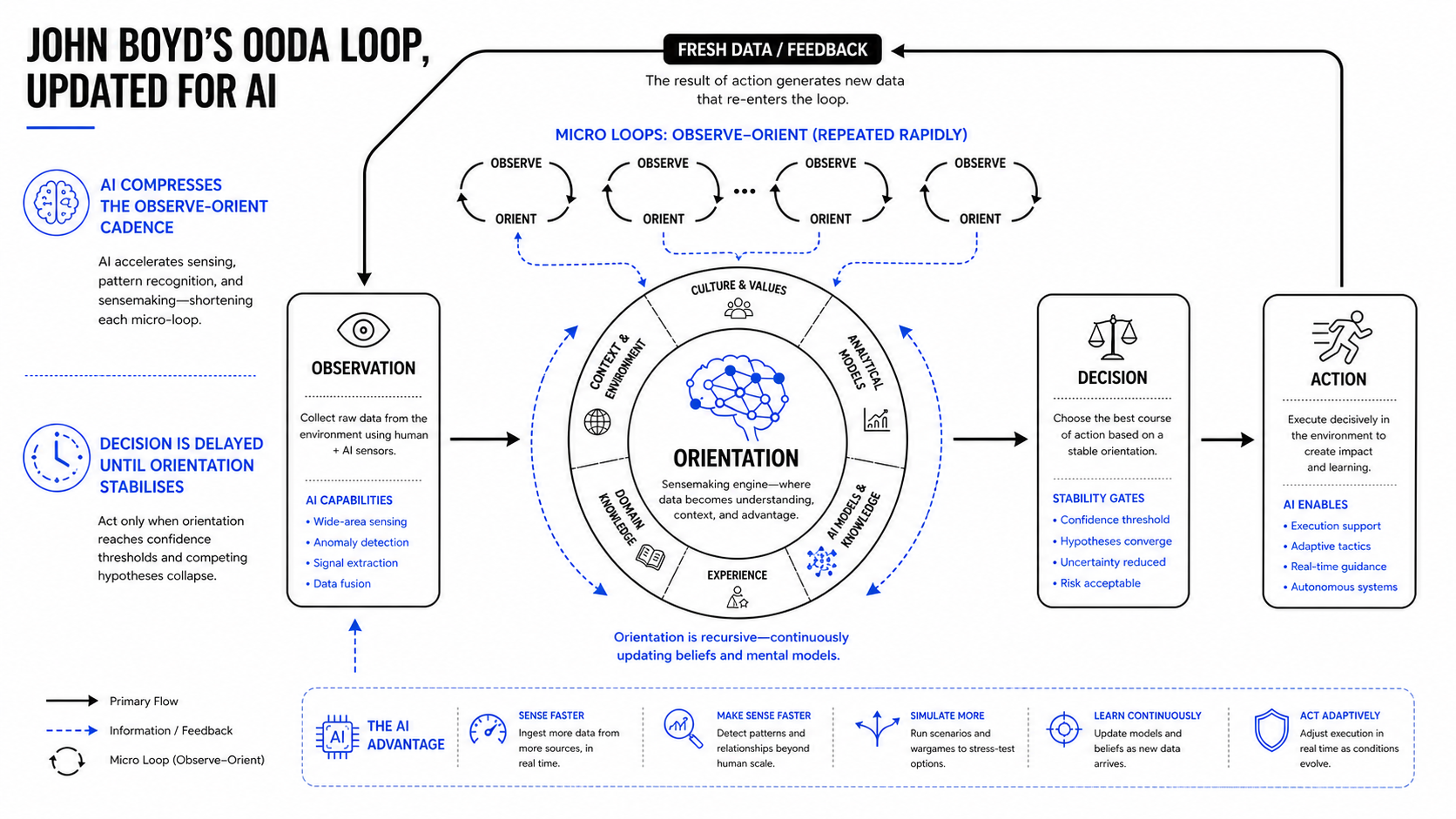
Seen in that light, the real effect of AI is not merely to shorten the time between observation and action. It is to change the cadence of the loop by multiplying the amount of observation and orientation that can happen before decision. Several observe-orient passes can now be run in the time it might once have taken to complete one. More evidence can be sampled, more analogies tested, more objections surfaced, more perspectives staged, and more weak interpretations discarded before commitment is required.
The two diagrams below show the contrast between Boyd’s original framework and the AI-shaped version discussed here, making the change in cadence visible at a glance.
That does not make judgment less important. It makes judgment more central. The machine expands the amount of work that can be done in service of judgment, but it does not remove the need for discernment. Someone still has to decide what question to ask, what frame to test, what voices to include, which outputs are superficial, which are generative, and when orientation has become good enough to justify decision. Recent work on AI and the OODA loop stresses exactly this point: orientation cannot be reduced to automated prediction because it depends on meaning, context, perception, heuristics, and adaptation under uncertainty.
In that sense, AI does not so much automate the loop as thicken its front end. It makes the observe-orient phase denser, more iterative, and more exploratory. Decision may still be slow, and sometimes should be slow, because the dependency remains human judgment. But the quantity of work that can now be done to inform that judgment increases dramatically. The gain is not just speed; it is cognitive range.
From artefacts to outcomes
This shift has practical consequences for the architecture of work. For years, professional activity often revolved around process: learning the method, documenting the method, auditing the method, discussing the method, and producing visible artefacts as proof that effort had taken place. AI unsettles that arrangement because it lowers the cost of producing intermediate material so sharply that the old equation between effort and value becomes unreliable.
A polished slide, a well-formed infographic, or a carefully argued note may still be useful. But its value now lies less in the labour embodied in it than in whether it changes understanding or advances the work. This is a difficult adjustment because beautifully made artefacts have long carried moral and professional weight. They looked like work. They were evidence of time, craft, and investment. Yet if something that once took weeks can now be produced in a morning, the real question changes: not “how much effort went into this?” but “did this help move the thinking forward?”
That is a salutary discipline. It suggests that the work is not complete when an artefact is finished, but when the task itself has moved on. In many cases, the right response to an AI-generated output will not be to archive it as a deliverable, but to use it as a stepping stone, discard it, and generate a more relevant model for the next stage of inquiry. The centre of gravity shifts from preserving output to improving orientation.
What Boyd, Sun Tzu, and Moltke might see
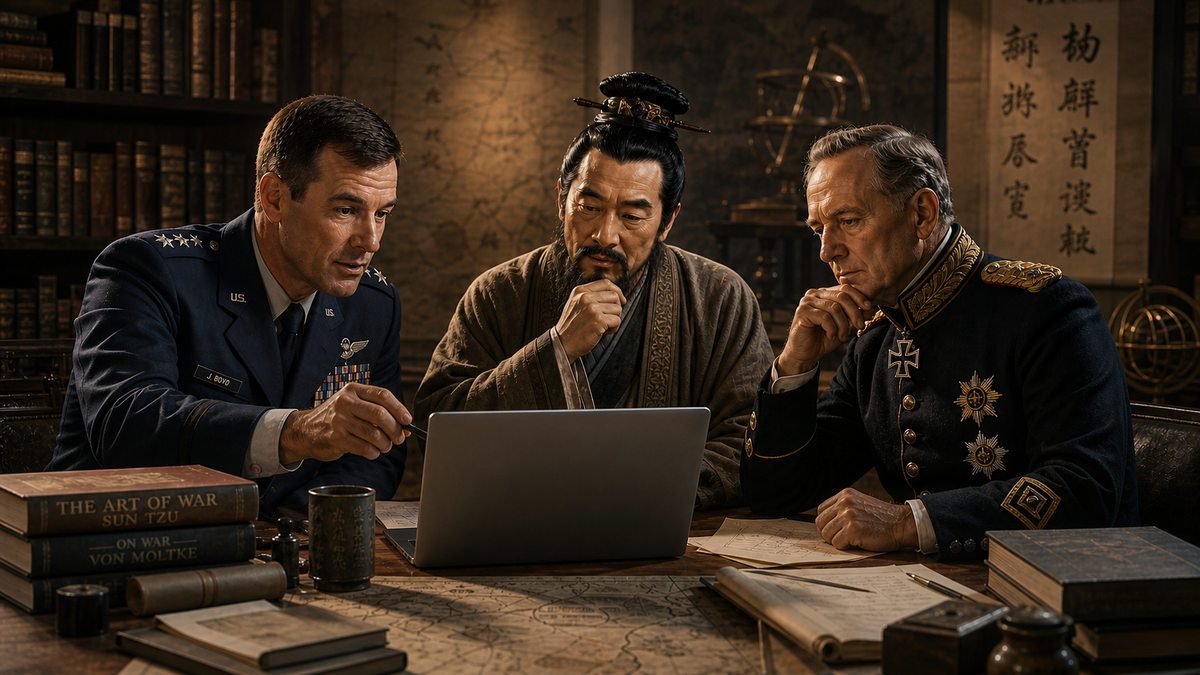
John Boyd was a U.S. Air Force fighter pilot and strategist best known for the OODA loop, a model of how individuals and organisations adapt under uncertainty. Sun Tzu was an ancient Chinese military strategist and philosopher, traditionally credited with writing The Art of War, one of the classic texts on strategy and deception. Helmuth von Moltke was a Prussian field marshal and chief of staff whose reforms helped shape modern staff planning, mobilisation, and command, and whose ideas influenced the rise of modern operational warfare. All three have long been staples of my bookshelf, and my evolving thinking.
This is where the strategic comparison becomes illuminating. Boyd would likely have recognised AI as a force multiplier for orientation, but only on the condition that it deepened judgment rather than seducing practitioners into mistaking speed for understanding. His concern was always adaptation under uncertainty, not motion for its own sake.
Sun Tzu would probably have seen AI as an amplifier of intelligence, ambiguity, and deception: a means of shaping perception before direct conflict begins. If AI helps generate more frames, test more readings, and better understand what others are likely to see, then it fits naturally within a strategic tradition concerned with indirectness and informational advantage.
Moltke, meanwhile, would likely have judged it by whether it strengthened disciplined initiative within intent. The attraction of AI would not lie in centralised omniscience, but in whether it helped people at the point of action orient themselves more effectively while remaining aligned to a broader purpose. On that reading, AI is valuable only if it improves adaptation without destroying freedom of movement.
What unites all three perspectives is the same warning. None of them would confuse better information processing with judgment itself. They would all see value in improved perception, timing, and coordination. But they would also insist that uncertainty, interpretation, and decision remain irreducibly human responsibilities.
The real message
The central point, then, is not that AI makes the OODA loop simply faster. It changes its cadence. The observe-orient side of the loop becomes more active, more layered, and more iterative before decision is reached. A larger volume of intellectual work can be carried out in the service of judgment, even if the act of judgment remains stubbornly human.
That may prove to be one of the most important shifts in knowledge work. The real contribution of AI is not that it decides for us, but that it allows us to test, challenge, and reshape our understanding at much higher frequency than before. If used well, it creates not a substitute for judgment, but a new environment in which judgment can operate with greater reach, greater speed of revision, and greater freedom to discard what no longer serves. That is why the key change is cadence, not merely acceleration.
Top Level Sources:
Boyd, John R. The Essence of Winning and Losing (January 1996). Boyd, John R.
Sun Tzu. The Art of War. Project Gutenberg edition.
Helmuth von Moltke. Britannica biography.
Comments ()