Alchemy
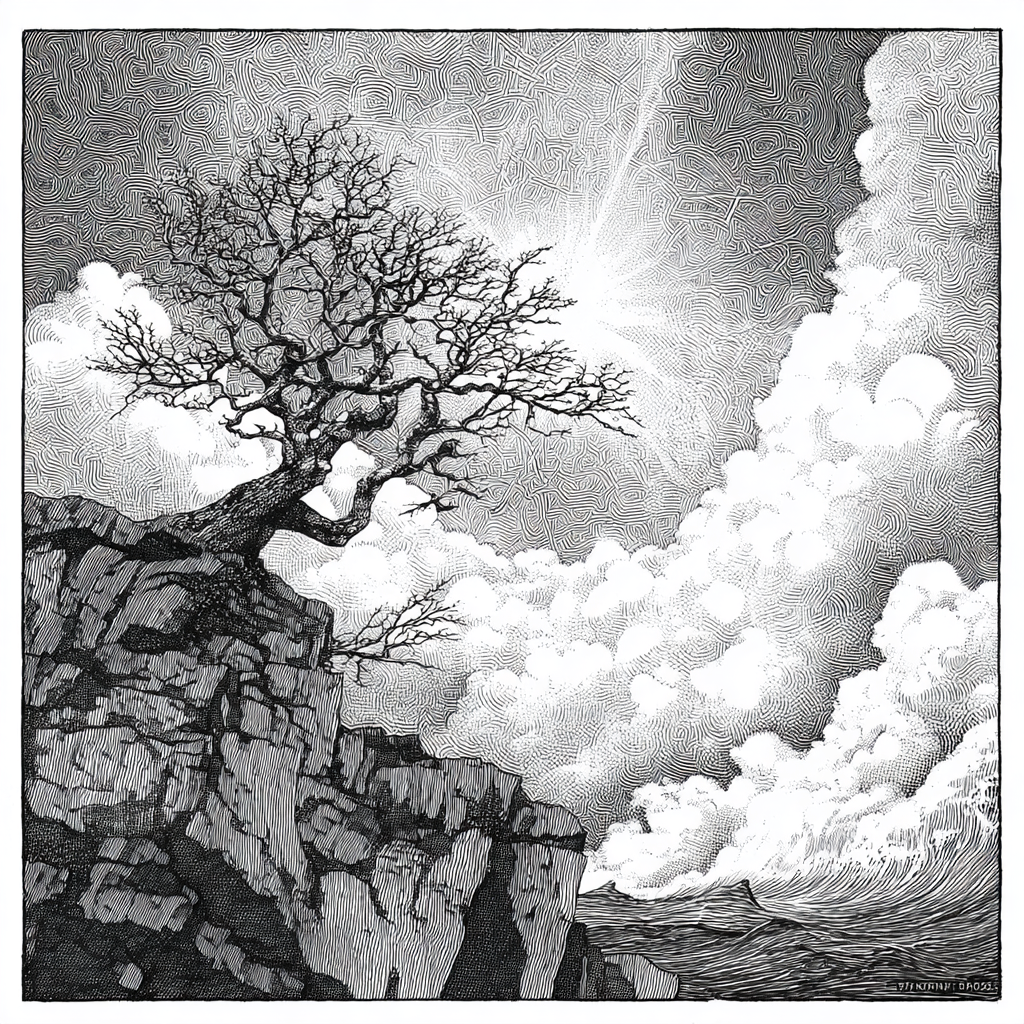
A Reflection on "Thin Space"
The idea of Alchemy is fractal; it happens at every level of being, from our individual psyches to the groups we form and on to the environments we occupy. Alchemy can be individual, at other times collective, and on occasion something larger altogether, like the "Thin Spaces" of Celtic myth and folklore, spaces where the boundaries of existence and meaning are more accessible than usual. As a Celtic saying has it, "Heaven and Earth are only three feet apart, but in thin places that distance is even shorter"
I think that the same is true of the space between who we are and what we do. Sometimes, we are fully engaged as who we really are, in "flow", where time is secondary, and the task is autotelic, a reward in itself. Goals, incentives and the tedium of measurement have no place. At other times, doing work required of us by others in exchange for reward, where there is no joy or discovery, just KPIs and OKR's, time takes on an elastic, endless quality. The clock, however carefully watched, moves slowly.
The more performative our workplaces, the slower the clock moves, and the more fleeting those opportunities for flow become. We are taken hostage by goals defined by others, waiting to be released by unloading the obligations that have led us to do the work we do, through good luck, retirement, or increasingly frequently, an email or short meeting with HR in the room. When that happens, in whatever form it takes, we would do well to be ready.
As a friend of mine said once about the idea that "The universe will provide", "It helps to give it a clue as to what you are looking for."
Thin Spaces and Athanors share qualities. While one is a spiritual geography, and the other a physical furnace, both are "liminal engines"; places where the veil between states is a semipermeable membrane, a space between the unsatisfactory known, and the possibilities of the unknown. Thin Spaces and Athanors have in common that they are points of transition, outside the noise of the thick spaces of daily survival, where the normal rules are suspended for a while. They also share a relationship with those who occupy them. They respond to intent, attunement, and acceptance that both the space and the occupant are part of the same exploration of possibility.
I think possibility has its own thin spaces. Just as we become the average of the five people we spend the most time with, so I think our goals exhibit something similar. If we spend our days pursuing goals defined by others, in pursuit of the measurable, then our own goals are likely to reflect that. Goals are like groups, they have insiders and outsiders, and the nature of the goals we derive in their company will reflect them. As an American friend told me ‘it’s hard to soar like an eagle if you’re surrounded by turkeys.“
We need our Athanors to find the space where can have new ideas that are not constrained by where we spend our days.
The Lunar Society was an Athanor, so was The Cafė Guerbois, as was the The Bayt al-Hikmak, the 9th Century Baghdad House of Wisdom, where the "fire" was the massive state-funded effort to translate all world knowledge into Arabic as it fused Greek philosophy, Indian mathematics, and Persian literature, leading to the birth of Algebra (Al-Jabr). Then there was The Bauhaus, where a weaver might spend all day with a carpenter, with the collateral result a unified aesthetic that defined the modern world (IKEA, Apple, and skyscrapers all trace back to the Bauhaus aesthetic). I could go on; Building 20 at MIT, cheap and "hacked together," where researchers could literally tear down walls or drill holes in the floor to run cables to other lab, and where linguist Noam Chomsky sat next to nuclear scientists and acoustics experts. At smaller scale, the "Inklings" at The Eagle and Child,
a small "Thin Space" in an Oxford pub where J.R.R. Tolkien and C.S. Lewis met and their shared love of Old Norse created the conditions that allowed The Lord of the Rings to become a cohesive reality rather than just a collection of fairy tales.
What they had in common was that they were about possibility, not money. They were places where questions were derived, not addressed. Once we have a specific question we have set conditions, and moved from possibility to definition. It reminds me of one of my favourite lines from Elspeth Huxley:
“The best way to find out things, if you come to think of it, is not to ask questions at all. If you fire off a question, it is like firing off a gun; bang it goes, and everything takes flight and runs for shelter. But if you sit quite still and pretend not to be looking, all the little facts will come and peck round your feet, situations will venture forth from thickets and intentions will creep out and sun themselves on a stone; and if you are very patient, you will see and understand a great deal more than a man with a gun.”
― Elspeth Huxley, The Flame Trees of Thika: Memories of an African Childhood
And another from Jidda Krishnamurti
“But we do not ask. We want to be told. One of the most curious things in the structure of our psyche is that we all want to be told because we are the result of the propaganda of ten thousand years. We want to have our thinking confirmed and corroborated by another, whereas to ask a question is to ask it of yourself.”
I think it offers in part an answer to a question I have been wrestling with;
‘what is the purpose of the Athanor?”
The answer is, I think that like alchemy and thin space, it exists outside any notion of purpose. It exists as a space to host possibility, and the moment we define what that possibility might be we move into a different space of the creative process, from alchemy to science, and from thin spaces to projects.
Inspired by Sue Heatherington yesterday, I think Athanors and Thin Spaces are in many ways poetic places:
BECOME AN EVERYDAY POET
listen
notice
stay curious
trust uncertainty
celebrate emergence
be graceful
choose hope
So, the Athanor will be shaped by what we bring to it, not what we expect of it.
I think that’s enough.
For those who can, our regular Zoom room will open at 5;00 pm UK on Wednesday 11th Feb
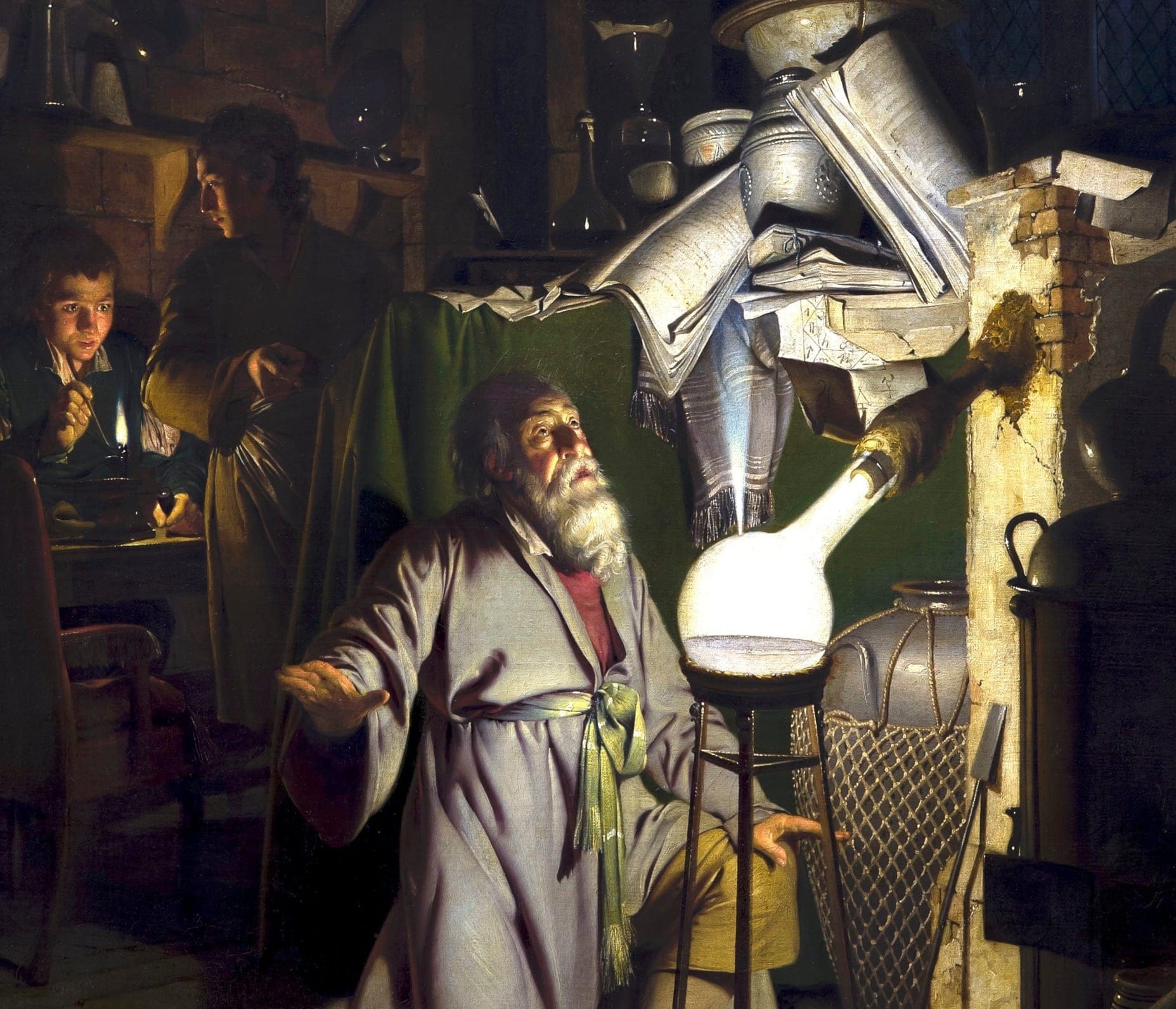
Hennig Brand, shown here in Joseph Wright’s painting was trying to produce gold. He got phosphorous. Not what he expected, but unexpectedly valuable.
We could do worse.
Comments ()