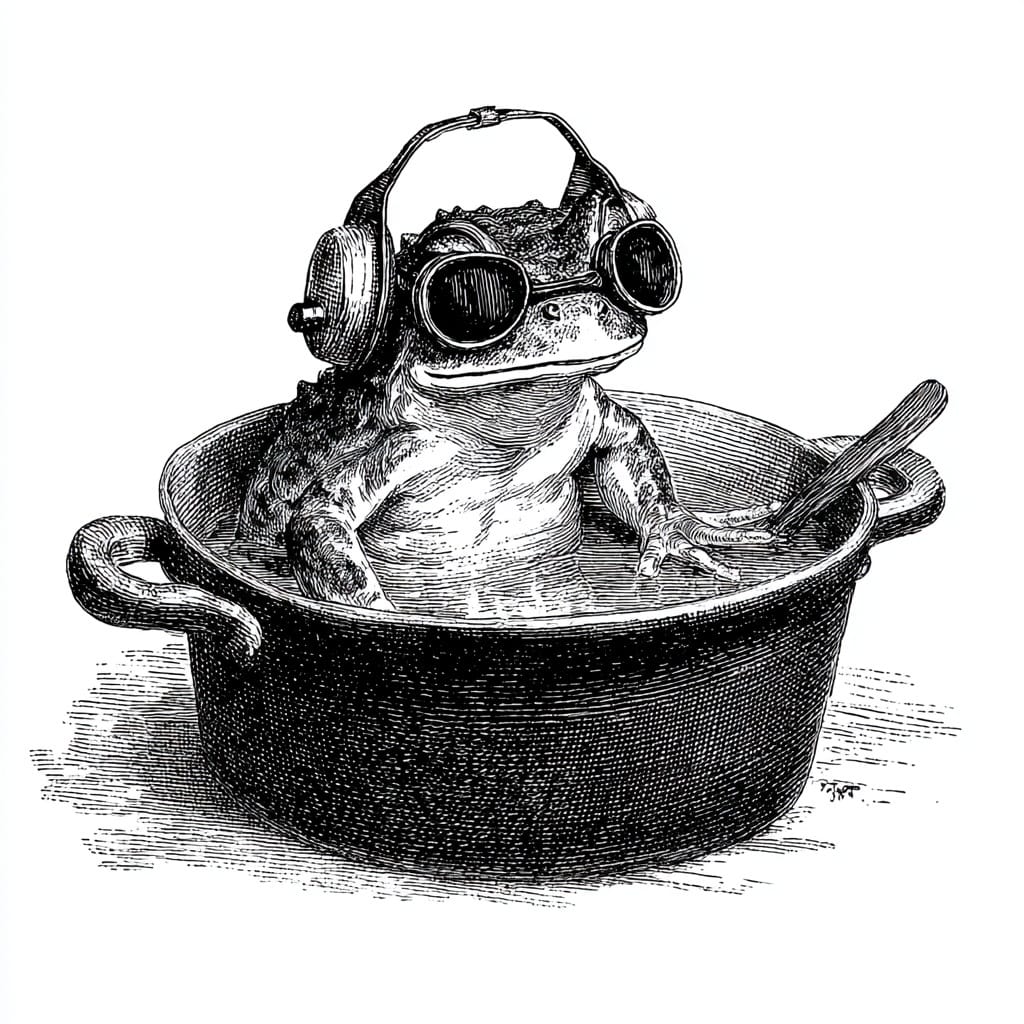
Alchemy, AI, and Soft Power.
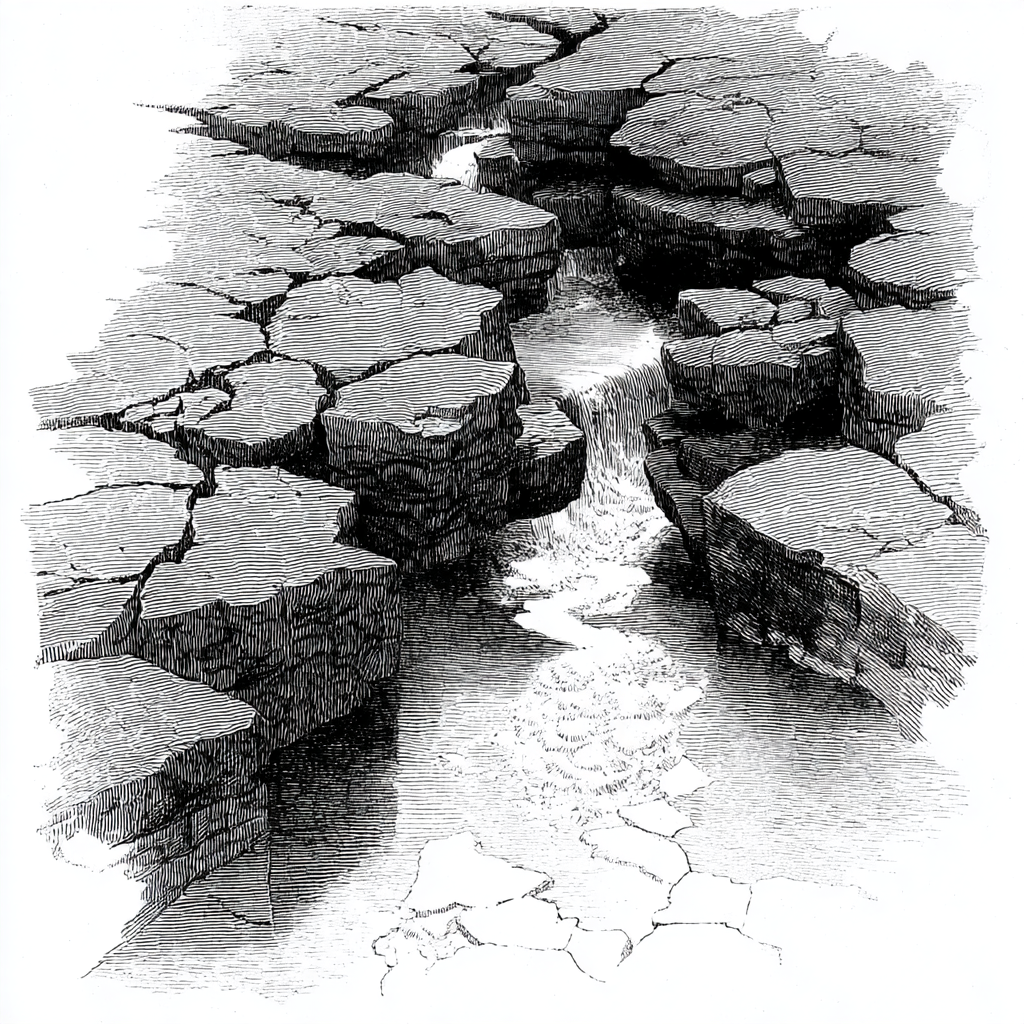
Hard power breaks things.
Right now, we find ourselves in a hard power world. The dominant power is overwhelming for us, whether that's in a geopolitical sense, a technological sense, or an economic sense. Geopolitically, everything else comes a distant second to the projection of military power. In technology, application comes a distant second to the power of compute, and economically, it's all about capturing resources. There seems to be remarkably little conversation about what happens once all these things have been achieved. It seems to be all about winning, with very little idea of what we'll do once we've won, whatever that means.
In the language of alchemy, hard power is a nigredo force.
The framing needs careful handling, because nigredo is often misread as simply destruction, something to be survived and moved past as quickly as possible. The alchemists understood it differently. Nigredo is neither failure nor aberration. It is the necessary first movement, the process without which nothing that follows can be real, and so the destruction is the precondition. What is being destroyed was never the substance that mattered; it was the attachment to form, the hardened structure, and the comfortable fiction that things can remain as they were.
The problem with the current moment is not that we are in nigredo; the problem is that we are in a nigredo that appears to have forgotten its own purpose.
The alchemist submits material to calcination because they are working towards something. The furnace is not an end in itself; it burns purposefully, and there is a theory of what comes next. What we are witnessing now, however, across the geopolitical, technological, and economic registers simultaneously, is a calcination running at full heat without any coherent account of what the ash is for. Hard power projection without political legitimacy, compute without considered application, and resource capture without a theory of what might be achieved beyond a story of more as an end in itself. The destruction is intense, but the intent beyond it seems remarkably thin.
Consider the geopolitical register first, because it is the most visible. The dominant logic is military projection and the credible threat of force. This is not new. What is new is the degree to which it has become self-referential, its own justification, disconnected from the question of what it is supposed to achieve. The United States military spent the better part of two decades learning, at enormous cost, that tactical dominance and strategic legitimacy are not the same thing. Boyd understood this. FM 3-24, the Counterinsurgency Field Manual published in 2006, tried to codify it: the population's orientation matters more than your weapons systems. Winning every engagement is not the same as winning. What you do to the material is not the same as what you do to the meaning.
That hard-won knowledge appears to have been largely set aside in favour of the simpler logic of overwhelming force. It is instructive that this should happen at precisely the moment when force has never been more overwhelming. The nigredo is at full heat. The question of what it is transmuting towards has been quietly dropped.
The technological register has its own version of the same pathology. The dominant discourse is about compute: scale, processing power, the race to build systems that are faster, larger, and more capable in narrow measurable terms. This is not wrong exactly; compute matters, but compute is episteme, formal codifiable knowledge scaled to extraordinary heights. What it cannot do is cross into mētis. The organisations capturing the most data are often the ones least equipped to read what it means. The Gaussian copula used for creating collateralised debt obligations was mathematically elegant but empirically catastrophic. Ratings agencies had all the data they needed in 2007; what they lacked was the contextual judgement to read what the data could not tell them.
We appear to be repeating the same category error on a larger scale, with more sophisticated instruments and equivalent confidence.
The economic register is perhaps the most structurally significant. Resource capture has become the dominant mode, but enclosure is not production. The historical record of resource-extractive economies is not a story of compounding advantage; it is a story of short-cycle gains and long-cycle fragility, of systems that become very good at managing their own internal processes while losing the ability to read the environment they depend on. Stafford Beer's diagnosis of systems that stop tracking reality and start tracking their own internal model of reality applies here with uncomfortable precision.
What unites all three is the same structural failure: nigredo without teleology. The burning has become the point.
This is where alchemy offers something that conventional political analysis does not. It names not just what is happening but what is missing, and what must follow if the work is to produce anything other than ash.
The operation that follows nigredo is albedo. The whitening. The clarification that emerges once the calcination has done what it can do. Albedo requires something that hard power cannot supply, and cannot be made to supply through more of itself. It requires reflection, discrimination, and the capacity to sit with what has been broken before reassembling it. A willingness to distinguish what is essential from what was merely habitual, to separate what matters from what was simply there because it had always been there.
Albedo requires a different energy.
Soft power, in Joseph Nye's formulation, is influence through attraction rather than coercion. Nye, who bridged theory and practice as Assistant Secretary of Defense under President Clinton, was describing something more than a diplomatic instrument: nations and individuals draw others towards them through the quality of what they embody rather than through the credible threat of what they can do. It is the albedo capacity; it clarifies, attracts, and makes the dissolved material available for new combinations. It is not weak, conciliatory, or the absence of force. It is something structurally distinct: the operation that makes force's gains durable rather than temporary.
This is the point that tends to get lost in accounts of soft power, particularly in a moment when hard power is so comprehensively dominant. Soft power is not what you reach for when hard power is unavailable. It is not the consolation prize. It is the operation that determines whether calcination produces transformation or simply ash. Without albedo, nigredo produces nothing that survives. It generates compliance without legitimacy, and suppression without resolution. Structures held in place by force rather than by the considered assent of those inside them, which means structures that will reorganise themselves the moment the force is withdrawn or distracted.
The United States discovered this in Iraq. The Soviet Union discovered it in Afghanistan. The Romans knew it well enough to build a system of citizenship and law that made their conquests mean something beyond the initial defeat. Hard power sets the conditions. Soft power determines what those conditions become. As in armed conflict, so in technology and economics.
The alchemical sequence has something else to say here, something less comfortable. If soft power is the albedo force, the whitening that follows the blackening, then it cannot be performed. It cannot be deployed strategically as an adjunct to the primary instrument of force, because albedo does not work that way. The material either undergoes the operation genuinely or it does not. You cannot calcinate and clarify simultaneously. The phases have their own integrity.
What this means practically is that soft power cannot be a tool in the conventional sense. It cannot be manufactured, scaled, or applied from outside. It emerges from the quality of character developed over time, through the kind of sustained attention and genuine risk-bearing that David Pye named the workmanship of risk.
It shows in the quality of work done with care, in the problems held rather than solved prematurely, and in the long accumulated evidence of contributions that serve something larger than self-advancement. This is what Nye was really describing, though he framed it in the language of international relations rather than alchemy: influence that operates through what you genuinely are rather than through what you claim or threaten.
In an age when AI can generate a competent first draft of almost anything, when credentials have become table stakes rather than differentiators, this distinction matters more than it has for a long time. The episteme is everywhere. The mētis is not. The ability to process and produce is ubiquitous. The ability to read the room, to sense when a negotiation is about to shift, to hold a question long enough that it changes the person holding it, these remain irreducibly human, irreducibly slow, irreducibly personal.
Hard power breaks things. That is not nothing. Sometimes things need breaking. The question the current moment is failing to ask is what should be built from the rubble, and who has the capacity to build it.
There is a scene implicit in every alchemical text, one that the grand language of transformation can cause you to overlook. The athanor is a furnace, and the furnace requires tending. Someone has to keep the temperature steady. Someone has to know when to increase the heat and when to let the material breathe. Someone has to resist the temptation to open the vessel before the operation is complete, to check on progress at the cost of the process itself.
The tending is not glamorous work. It is not the work that gets written about. It is the work of sustained attention, of care more than analysis, of trusting a rhythm developed over time rather than reaching for an instrument every time the anxiety becomes uncomfortable. It is craft in Pye's sense, workmanship of risk, where the outcome depends on the judgement of the person doing the work rather than the specification built into the system.
This is the work that is most needed in a nigredo world, and least likely to be valued by it. The nigredo logic rewards force, speed, scale, and decisive action. The albedo logic requires patience, discrimination, and the willingness to sit with dissolved material rather than resolidifying it prematurely into something familiar.
The Lunar Society did not try to stop the Industrial Revolution. It did not oppose the force that was transforming England. What it did was assemble at the edge of institutional life, at the boundary between what had been and what was becoming, and develop the quality of thinking that the next phase of the work would require. Watt, Priestley, Boulton, Wedgwood, Darwin, Edgeworth: people who understood craft and mētis and the long, slow process of genuine transformation, building the capacity for what came after the breaking.
That seems to me the right model for what the current moment asks of those of us who are not in the business of hard power but are going to have to live with its consequences, and eventually, when the furnace cools slightly, contribute to whatever comes next. Not resistance in the reactive sense, or withdrawal. It asks for the deliberate cultivation of the albedo capacities, the soft power qualities that no amount of compute or military projection can manufacture, and that the next phase of the work will not be able to do without.
Hard power has its limits.
I am convinced there is a craft to this.
I am inspired by C. Thi Nguyen's work on the nature of games, Joseph Nye's work on soft power, and Rory Sutherland's work on the creative nature of alchemy. I am increasingly impressed by the potential of AI when considerately harnessed. I used the prompting format I described in my "Experiment" posts here to research this article, using work I was familiar with to surface work I wasn't, in this case David Pye's work on the workmanship of risk.
I will write a piece on New Artisans on how this might emerge as a practical craft in changing times, and aim to have it posted by the end of the week.
Comments ()