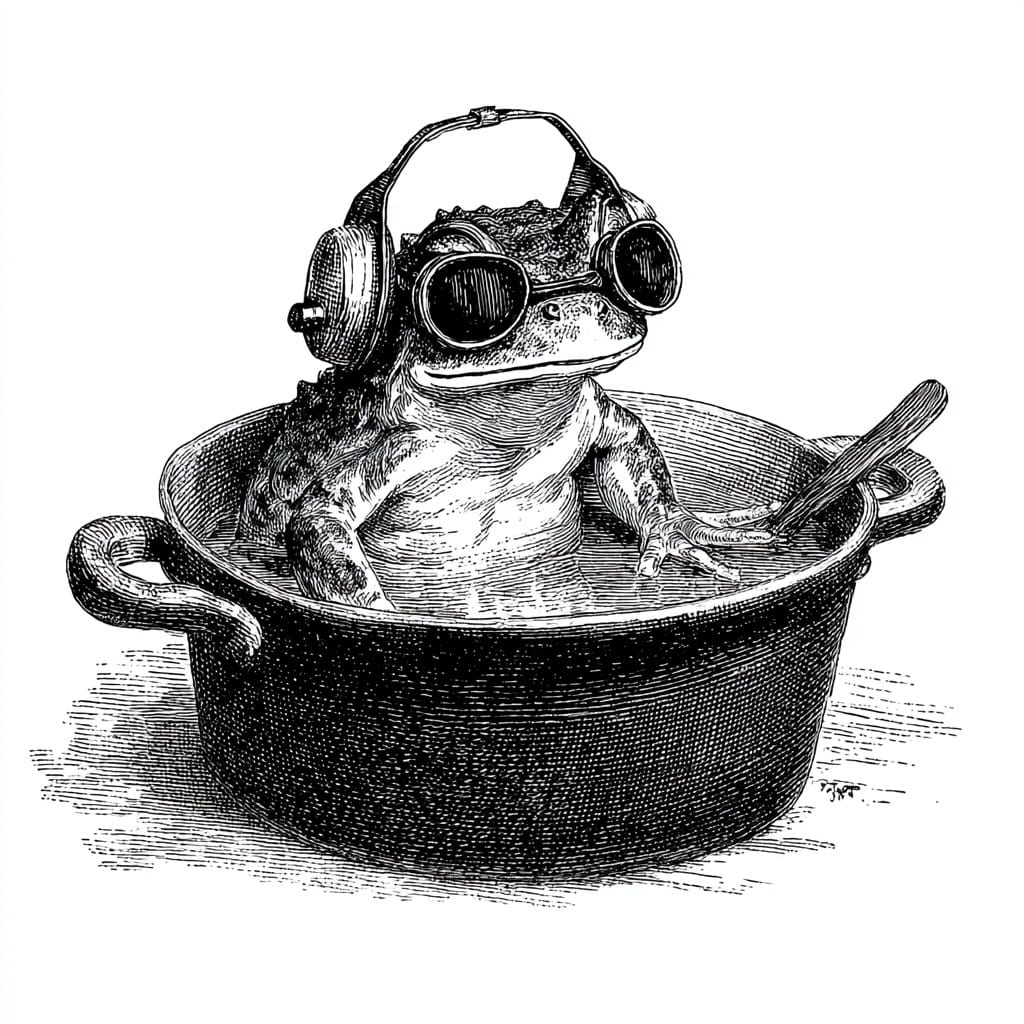
Prima Materia
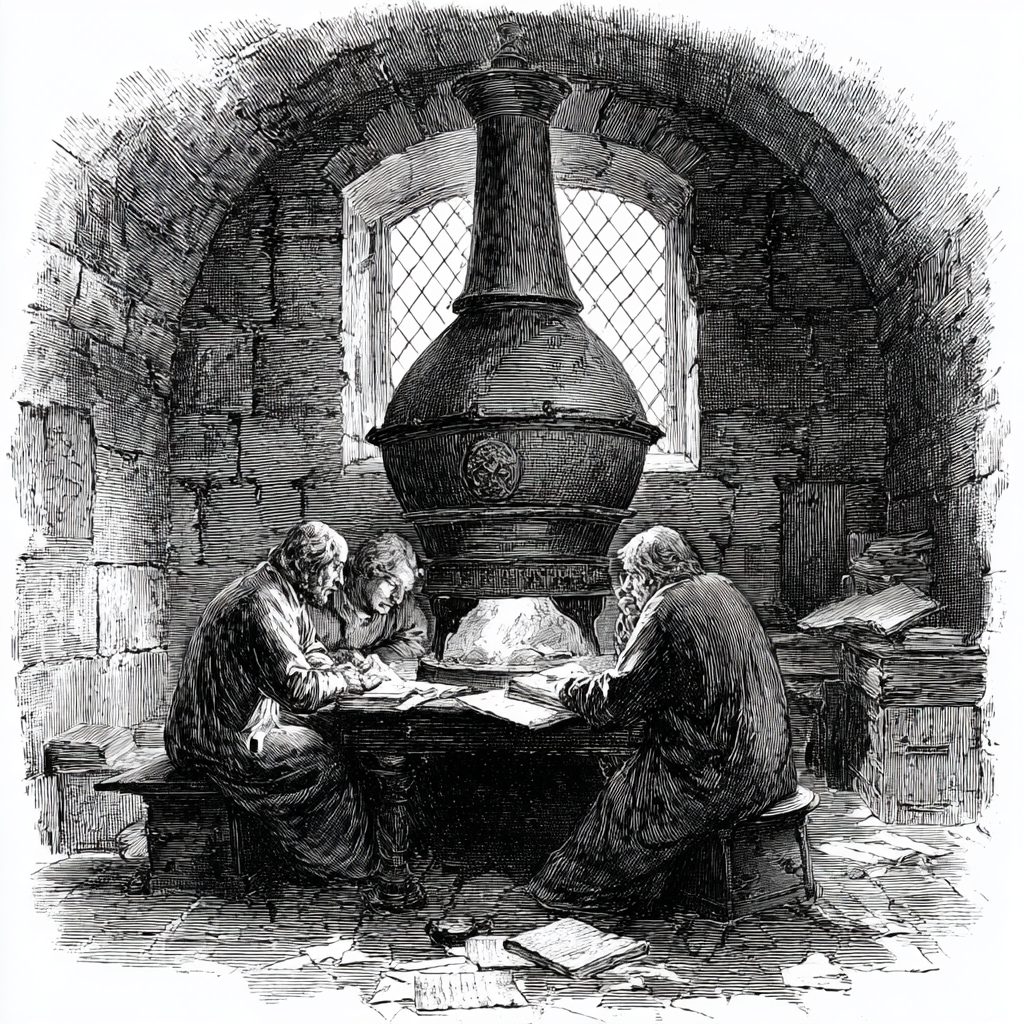
What We Bring to the Vessel
Slow conversations, without agenda have been a central part of my practice for so long now I had almost forgotten they were deliberate choice made during a difficult time when we did not know what was happening. Not slow in the sense of being short of pace, but slow in the sense that the people in them have taken the time to do the reading, taken the walks, and sat with their unease for long enough that what they bring is not raw material but already partly worked.
We do not have to have a goal when we think, thinking is an exercise in autopoiesis; an exercise worth doing for its own sake. The best conversations are ones that surface, and help complete “ideas in progress”
I have been turning this over for a while. The Athanor, as I have been using the word, is the slow furnace of alchemical practice, the kind of fire that holds at temperature for as long as the work requires. Inside the vessel sits the crucible that holds what is being prepared, the vas hermeticum, sometimes called the philosophical egg which holds the prima materia, the material being transformed. Around the athanor sit the participants.
What comes out depends, more than anything else, on what went in.
The quality of the prima materia determines what the work can become. No tool, no ally, no clever process recovers inferior material. You can run a degraded conversation through the most sophisticated machinery in the world and the answer at the end of it will still be a degraded answer, only delivered faster, with more confidence, dressed in the shape of a finished thing.
What counts as material? Three things, layered. The first is the qualities of the people in the conversation: what they have read, how long they have thought, what they care enough about to argue with. The second is the relationships between those people, and the conversational habits they have built together over time. The third is the quality of the material being drawn upon. The books, notes. and the half-formed ideas in the margins. The working papers nobody has yet finished, containing ideas that have not yet found a home.
Each of these is upstream of anything we might call a strategy, a philosophy, or an analysis. None of them is automatic, and none of them can be outsourced. We have to do the work. Thinking is a craft in itself.
The reason this needs saying now is that we are at a moment when the temptation to skip the thinking has never been stronger. The tools have arrived that make it possible to begin with the deliverable. Type the prompt, get the document. The machinery is becoming ever better, and markets hungry for efficiency and productivity reward speed.The incentives run entirely in one direction.
The argument of this post is the opposite. The arrival of these tools is, for the practitioner who notices, an opportunity to do the work of thinking more deliberately, not less. What follows below the line is an account of what that looks like when I try it: the new old skill of stream before structure, with the inner critic out of the room, when curiosity more than profit fuels the fire and what this changes for those of us who advise.
Stream Before Structure
There is a habit I have found myself aware of, so familiar it was almost unnoticeable until I started the work I am now doing. I notice it when I sit down to write, or preparing for a conversation I expect to be difficult, or on a schedule determined by someone else. I begin, almost without realising, to structure. I find myself reaching for the shape of the argument before I have the argument, rearranging the order of points I have not yet written. I draft headings, sketch a trajectory, and focus.
Of itself, it is not a bad thing. There are pieces of writing for which it is the right approach, but for the kind of thinking that has to happen at the boundary of what I do not yet understand, structure-first is a trap. It commits me to a shape before I know whether the shape fits the territory. It exchanges the discomfort of not yet knowing for the false comfort of a tidy outline. It encourages me to lean on the familiar, the recognised and reputation and tame the heretic in me. The thoughts that would have surprised me, had I left room for them, stay quiet.
I think of this as an instilled template, a product of school, professional life, and a long training in producing legible outputs to a deadline. It is one of the things David Pye would recognise as the workmanship of certainty making itself at home in places where what is needed is the workmanship of risk. The inner template knows what an expected document looks like, but is frightened of what a deliciously heretical thought feels like at the moment of its first arrival.
This new, old, skill as I have come to think of it, is the deliberate refusal to structure too early. It is the choice to put down the thought as it actually came, in fragments if it came in fragments, without rehearsing it into the shape it will eventually take. To walk around it, share it with those others around the athanor, and let it take shape of its own accord. This is what stream of consciousness offered the modernists, and what has been more or less unavailable to people in working life since, because the cost of producing two drafts, one a stream of thought, and one structured, was prohibitive in a world where the structured one was the expected deliverable. Clients often want a ready meal, not a tray of exciting, unfamiliar ingredients that need the preparation only they can do.
That is changing. The cost of accommodating the stream has come down. Structuring can be done later, with the help of technology. What we are being given back is the slow hour at the start, where the thinking can happen at its own pace.
The danger is that we use it to produce more mediocrity.
The Inner Critic, Out of the Room
There is a related move, harder to describe and just as important. The inner critic is the part of our mind that thinks it knows in advance how what we are making, or doing, will be judged. It edits before the sentence is finished, and stops a half-formed thought because it sounds half-formed. It sends a fragment back for revision before it has had time to reveal what it was actually about.
For most of my working life, the inner critic and the structure-first habit have been the same instinct, working in tandem. They are both, in their own way, anticipations of an audience we want to please. They are both forms of premature legibility, and they are both the wrong instinct for the early stages of any work that lives in the territory of dynamic uncertainty we find ourselves in. Mervyn King and John Kay make the point in adjacent terms in Radical Uncertainty: when the situation is genuinely beyond the reach of probability, the disciplined production of plausible-looking analyses can be worse than no analysis, because it disguises what is not known.
What I have noticed, working this way for a while, is that the inner critic loses much of its grip when the structuring is no longer my job at the moment of writing. It lets me put down things it would otherwise have refused, lets me leave loose ends, and lets fragments stay fragments. The patient dialogue Donald Schön located at the centre of reflective practice, the long loop between thinking and doing in conditions of ambiguity, depends on this. The critic does not need to be silenced; it needs to be moved further down the line.
What the AI Does, So I Do Not Have To
I have come to understand how AI (in my case, Claude Opus 4.7) used with care, takes the episteme side of the work for a while, and gives me back the mētis side. This is an unusual division of labour, and worth explaining a little. The episteme is what can be written down and recorded; it is the explicit, codified, and the structurable, born of the need for evidence. The mētis, in James C. Scott's reading and in the older Greek sense, is what cannot. It is the embodied feel for a situation, the judgment that survives in practice and resists the rule book, and is born of a love of the work we do.
The capacities most at risk in a default-mode, performative AI deployment are the mētis capacities; the capacities crowded out when I spend my slow hour on the structuring task, because structuring is an episteme operation.
If the structuring can be deferred, so that an AI ally can carry it later, on demand, from a body of fragments I have produced freely, then the slow hour at the start is freed up for the work I am best at. The work of noticing. The work of holding a question open longer than the inner critic finds tolerable, and the work of letting the next thought arrive on its own time.
AI does not do the thinking. It is the opposite. The thinking is mine to do, and now I can do more of it, because the formatting has been moved downstream.
Texture, and What Does Not Travel as Fact
I broke off from drafting this piece for a while and had a conversation with someone whose thinking I trust and value. What came to me afterwards was that the material I have been describing is not flat; it has texture. It is not just a matter of facts, even good facts; it is the layered presence of mētis, of psychology, of the small signals that accompany an idea as it travels and need time to find their right place in a sentence.
Some of this is what Iain McGilchrist has been arguing in Ways of Attending: that the mode of attention we bring to something shapes what we are able to see in it. The narrowed, grasping attention sees one thing. The open, contextual attention sees another. Both are available, even if most institutional life selects for the first.
Some of it is what Daniel DeNicola gets at in Understanding Ignorance, where he distinguishes the kinds of not-knowing that are productive from the kinds that are merely empty. A practitioner who has lived inside a question long enough to know its shape carries a different ignorance than someone who has not yet asked it. Both can say "I do not know." Only one of them is in a position to do useful work with the not-knowing.
Some of it is closer to what Richard Sennett locates in The Craftsman, in the slow conversation between hand, eye and material that no instruction manual can substitute for. The craftsman knows things about the wood that the carpenter's training manual does not contain.
The reason this matters for the prima materia argument is that an answer trained only on the explicit will reproduce only the explicit. Texture does not travel unless we put it in, and it arrives in conversation through the off-hand observation, the half-laughed aside, the reading list someone shares because they happened to remember it, or the discussion paper that has been sitting in a drawer for two years. None of this is on the company intranet. Most of it is barely written down at all.
The work of turning material into usable substrate, then, is not a matter of accumulating more inputs. It is a matter of cultivating the kinds of inputs that carry texture. It is closer to gardening than to process.
I made some of this argument at greater length in a Prima Materia discussion paper I wrote to myself that sits in the Athanor working files. That paper read three contemporary articles on AI philosophy, and pushed at the place where they stopped short. This piece picks up where that one left off, but moves from the diagnostic register to the practical one. If substrate is what the work depends on, what does building it actually look like.
What This Changes for Those of Us Who Advise
For those of us who work in any kind of advisory capacity, there is a specific shift worth naming: The traditional path for the advisor was to abstract upwards. You took what you knew and you turned it into a proposition, a book, a presentation, or a training programme. The audience was assumed to be plural, and the deliverable had to be portable enough to travel across that audience without requiring too much rework. The artefact, in other words, was always at one or two removes from the conversation it came out of. The cost of taking the conversation that derived the artefact to a single reader was prohibitive.
That cost has come down too. With substrate of sufficient quality already in place, a body of working papers, a reading list, a record of conversations, the writer's own back catalogue, it becomes possible to filter that material against the precise question a single person is bringing. Not a generic version of their question. The actual question. In their context. With their constraints. Framed in their terms. AI has a bigger working memory than we do.
This is a different shape of work from anything the consulting model was built around. It is closer to the older sense of counsel, and it depends entirely on the substrate being there in the first place. Without it, the same operation produces only generic plausibility, dressed up to look bespoke. The model cannot give back what was never put in.
This is where the discipline of the long, slow build matters. The reading, the writing, the careful conversations, and the discussion documents that no one has read yet; all of this is the substrate from which contextual counsel becomes possible. It is also the work the market has the hardest time pricing, because it has no deliverable until somebody comes looking for it.
Nigredo:What the Athanor Burns Away
The athanor's function, in the original sense, is not to produce. It is to transform. It holds heat over time so that whatever is in the vessel can become what it has it in itself to become. There is no shortcut to this, and no improved version of it that runs faster.
What I have come to think the athanor is also doing, in this present moment, is burning away an unwanted legacy that is the set of structuring instincts I have been describing. The inner critic, the instilled template and the assumption that legibility comes first. These were not stupid habits, they were appropriate to a working life in which the deliverable was always the shape of the work. They are, though, in the new arrangement, often in the way.
The athanor's slow fire does not destroy underlying capacities. It burns off the sediment that has built up around them. What is left, in the better cases, is the older thing, practitioner's stance. That slow hour and the unhurried question, in a form that can finally meet the tools without being absorbed by them.
I do not think this is a conclusion, it is more like a position from which to continue working, and the questions I left open in the Prima Materia paper are the questions I am still holding. What does a philosophy that is not a deliverable actually look like? Where, in the present market, does substrate get formed at all? What practices would constitute an athanor for the kind of thinking the new tools both threaten and enable?
I will keep working at these, knowing that by the time I come back to them, they will be different. Change is not episodic.
References drawn on in this piece, from the core booklist and Athanor working files: David Pye, The Nature and Art of Workmanship; James C. Scott, Seeing Like a State; Mervyn King and John Kay, Radical Uncertainty; Iain McGilchrist, Ways of Attending; Daniel DeNicola, Understanding Ignorance; Richard Sennett, The Craftsman. Also: the Prima Materia discussion document (Athanor working papers, April 2026), and Donald Schön's account of the reflective practitioner.
Comments ()