The Craft of Distillation
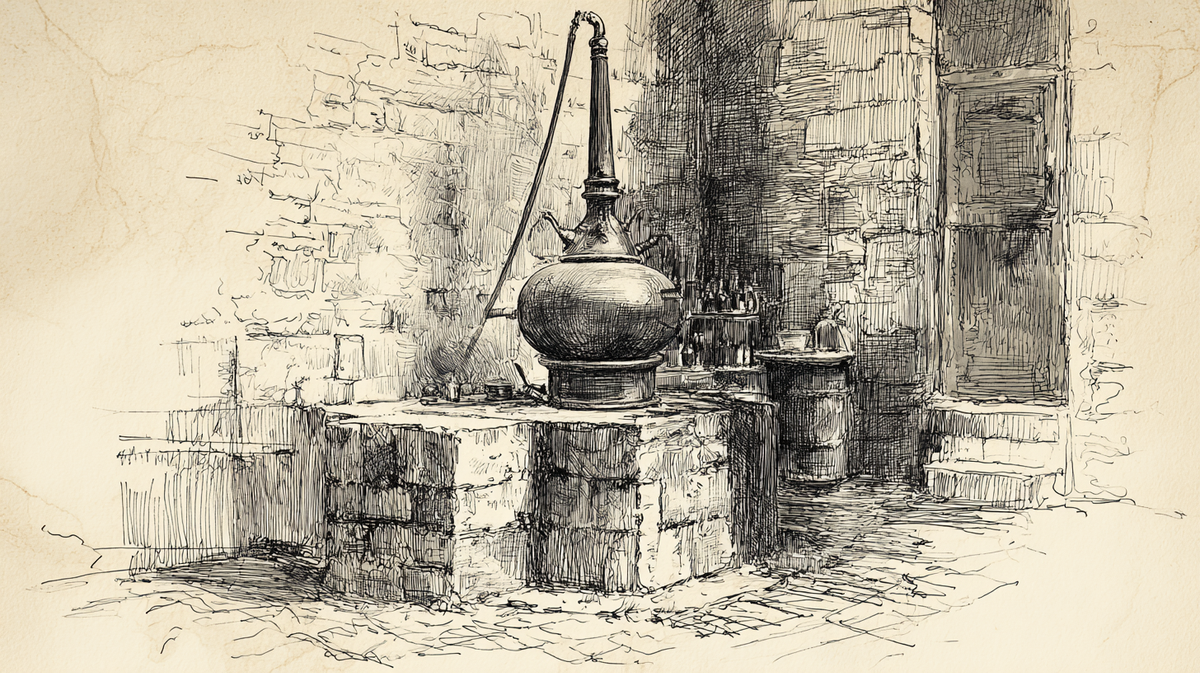
When did you last wash your car with bottled water?
The question surfaced in a recent conversation, as we talked about the habit of reaching for what has been processed rather than tending to the raw material in front of us. It stayed with me, because that is increasingly how we seem to be turning to AI. The remarkable thing about these tools is not that they can do, more cheaply, much of what people already do; it is what lies beyond that. Yet under pressure, and perhaps under the weight of mimetic forces, we find ourselves using them to do, a little worse, the very things we might have done ourselves. And like bottled water, the more we grow used to them, the more we will default to them; we will treat them as a consumable, use them carelessly, and stop asking after the quality of the source.
I have always disliked the word “consumer”. It defines us by our appetite; it makes consumption, rather than creation, our first purpose. What troubles me is that the same habit now threatens to attach itself to intelligence. We risk treating AI as something to consume rather than something to use; a kind of super search engine, drawn upon for the quick and the average, rather than an instrument for pushing thought into places it has not yet reached.
This train of thought began, of all places, at the start of a holiday. We set off for early and found ourselves at a surprisingly good restaurant at East Midlands Airport called The Alembic. Serendipity, perhaps, doing its quiet work; for the alembic was a central part of the alchemists’ toolkit, and it has one or two things still to teach us. It worked alongside the athanor. The athanor was the furnace; it supplied the slow, steady heat. The alembic was the vessel; it held what was to be distilled. Between the two of them, patience and refinement.
The alembic has three parts. First the cucurbit, the lower vessel of copper or earthenware, where the wash, the wine, or the macerated petals sit and the heat is applied. Then the anbik, the head, which sits over the rising vapour and lets it cool against its walls; this is where the first separation happens. Finally the receiver, reached by a downward-sloping spout, where the condensed liquid trickles down to be gathered. What strikes me about the device is the assumption built into its very shape: that you cannot reach the essence of a thing by going faster, and that you must instead accept several patient passes of going slower.
So much of the alchemists’ language has since become ordinary speech. By the fourteenth century, “alembic” was already a metaphor for the mind; for thought and memory; for the place where raw experience is refined into wisdom. The instrument had become a figure for slow refinement long before any faster alternative was so much as dreamt of.
The alembic has a long lineage. It reaches back to Maria the Jewess in the early centuries of the common era, the Alexandrian alchemist from whom we also inherit the bain-marie, that gentle water bath still beloved of French cookery; the first contribution to the art of a kinder way to apply heat. From there it travelled: refined in eighth-century Persia, carried into Christendom through the school of Salerno, brought at last to Scotland and Ireland, where it gave us uisge beatha, the water of life, whisky. At no point on that journey did anyone try to make it faster. Every hand that touched it sought greater fidelity, not greater speed.
Then, in 1830, Aeneas Coffey, an Irish exciseman turned distiller, patented the continuous still. It was not a refinement of the alembic; it was an entirely different animal. It was, in effect, a factory: capable of enormous output, distinctive because it produced a continuous flow rather than a batch. Within a generation it had transformed gin, whisky, and industrial alcohol, and it is now responsible for the overwhelming majority of the world’s spirit by volume.
But not by quality.
What Coffey gave us was continuous operation; very high strength in a single pass; far less labour for every litre. The result was a near-perfectly reproducible neutral spirit, and the economics of scale. What it took away was character. It took away the congeners, the heavy volatile compounds that carry character: the esters, the aldehydes, the fatty acids, the fusel oils. The slow, inefficient pot still keeps them, and gives you a spirit with a face; the continuous still strips them out, and gives you a spirit with a function.
Here, perhaps, is where my bottled water belongs. Bottled water is a continuous-still product: stripped, uniform, endlessly reproducible, consumed without a thought for its source. The alembic stands for the opposite habit of mind. The one is industry; the other is craft.
Working the alembic is a craft, and the craft is in the cut. Each distillation gives three parts. First the heads, the first vapour off the still, volatile and harsh, to be discarded or held back for the next run. Then the hearts, the middle cut, the clean spirit that carries the flavour-giving congeners; this is the point of the whole exercise. Last the tails, oily and dull, where the run is allowed to end. The art lies entirely in the timing: in knowing when the heads give way to the hearts, and the hearts to the tails. It cannot be settled in advance, because every batch is different. There is even a kind of second thinking built into the copper itself; vapour that rises too heavy meets the cooler neck, fails its test, and falls back to be distilled again. Revision, rendered in metal.
And here is the lesson I take from it. The master distiller makes that cut in seconds; but he makes it well only because of the thirty years standing behind it. The speed is real, yet it is only the visible tip of a great deal of accumulated patience. The fast judgement is earned, slowly. This is what Kahneman would recognise as the two systems of mind: System One, fast, intuitive, pattern-matching, almost effortless; and System Two, slow, deliberate, serial, expensive to run. We are tempted to think them rivals, and to prefer whichever is the quicker. But the truer relation is that the slow system lays down the patterns the fast one later runs. Fast thinking is downstream of slow thinking. There is no fluency that was not, at some earlier point, paid for in patience.
Those of you who have watched YouTube videos on using Claude or any other AI will recognise the pattern. Commitment to manic output rather than quality of content, unless we're really careful and race to the bottom. A generative model is a spectacular continuous still: it runs without pause, pouring out vast volumes of fluent, neutral, broadly competent work. The temptation, under pressure, is to take whatever comes off the still as finished; and what you get, if you do, is high volume and an undifferentiated average. It is fluency without the apprenticeship that ought to have earned it; System One with nothing of System Two behind it. The work, as ever, is in the cut: in knowing what to keep, what to discard, and what to put through again. We can treat the model as a continuous still, and consume what it pours; or we can treat it as an alembic, and use it to refine our thinking; knowing when to begin, and, just as importantly, when to pause. I have written at New Artisans and Outside the Walls about the importance of Craft and Métis as the things that no amount of technology can replicate.
I wonder whether they have ever been more important or more at risk?
For those of us gathered here, the parts fall into place. The conversation is the athanor: the slow, steady heat; the patient warmth in which anything worthwhile can develop. The athanor had an old nickname, fittingly enough; the alchemists called it Piger Henricus, Slow Henry, and there is a quiet dignity in an age that could praise a thing for being slow. The model is the alembic, the instrument of refinement; and we are the distillers, standing at the receiver, making the cut.
So much for the theory. It is time to put it to the test. Over the coming month or so we will run a few trials with real people in real businesses; the conversations serving as the athanor, Claude Teams as the alembic, and the judgement, as it must be, left to us. The craft will be in the cut.
I will keep you posted.
Comments ()