The Nature of Alchemy
There was a brief, hubristic period in organisational development when we convinced ourselves that change could be managed, designed even, to meet our hunger for performance. It didn't last long. Change is like the weather - something we can see patterns in, forecast to an extent, but cannot manage. The old adage that "there is no such thing as bad weather, just unsuitable clothing" applies to change as much as the weather, and whatever form it takes, from Typhoons to Technology to Trump, it rarely arrives by invitation. It just rocks up and asks us questions.
As I write this, our societal clothing seems hugely inappropriate, like wearing fast fashion in an arctic storm.
I've written elsewhere that what we are in feels more like phase change, and just as we have taken a long time to accept that climate change is real, no matter what creative label we apply to try and tame it, so I think we must also accept that we face civilisational change. It's an uncomfortable thought that we are in what we would rather read about in historical accounts, but this is happening on our watch. Like Hemingway's description of bankruptcy, what has been happening gradually has become suddenly.
There is no single story of how civilisations change, only a set of recurring ways of noticing when something has begun to slip. Some accounts describe a long arc, in which early energy and confidence slowly give way to comfort, abstraction, and fragility. Others push back against the idea of a timetable altogether, suggesting that societies falter not because they are old, but because they lose the capacity to respond creatively when circumstances shift. Still others look to the quiet erosion of social bonds, as shared purpose thins and private advantage takes its place, or to the build-up of internal pressures that make systems brittle from the inside long before any external shock arrives. A more recent strand frames these moments as periodic reckonings, when unresolved tensions resurface and demand attention. Although different in emphasis, these perspectives converge on one insight: civilisations rarely end in clean breaks. They drift, unbalance, and reconfigure, often for decades, before we can name what has changed, or accept that we are already living inside the transition.
There's a desperate temptation to try to analyse what's happening in the moment, to "follow the science" in order that we can somehow fix it. Perhaps we might have been able to do something about that during the "gradually" phase, but now that we're in the "suddenly", it's too late.
Alchemy feels like a remarkably appropriate lens through which to consider what is happening. It may not have the rigour of science, but that is secondary because we don't have the raw material for science in terms of what is happening; what we are facing is unique, individually and collectively. None of us have been here before.
The Nature of Alchemy
One of my favourite, simple models is Roger Martin's funnel:
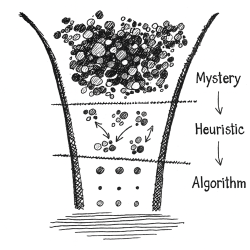
The industrial age has driven growth by turning what those before us discovered into useful heuristics into powerful, replicable, efficient algorithms. Along the way, though, we have sidelined those who followed inefficient, perilous, uncertain paths of discovery, who turned mysteries into heuristics. Those who gave us what we have perfected to the point of obsolescence were artists and philosophers. polymaths and heretics - those like The Lunar Society, The Vienna Circle, and The Bauhaus, characterised by small numbers with high trust, crossing boundaries in the context of historical tensions that demanded the synthesis of new ideas.
What we have now, whilst productive in an exploitative sense, is in danger of becoming sterile in an exploratory one. Corporations remember by embedding the past in structure, algorithms remember by encoding the past in rules, and AI consolidates the past by absorbing it as probabilities. We have lost sight of the power of meaning and purpose as the engine of progress. Unless we change that, we will run out of messy, inefficient, incomplete heuristics to work on.
Alchemy is much better for looking at where mystery meets heuristic than science, where heuristic meets algorithm. When it comes to dealing with what we're facing, we need new ideas and a willingness to accept that the economic inefficiency of being approximately right is far preferable to the sterility of being precisely wrong.
Alchemy: Nigredo - Albedo - Cintrinitas - Rubedo. A journey from disintegration to reintegration at a higher level.
Nigredo
Nigredo is the necessary decomposition that precedes genuine transformation. It separates what we've been holding on to through familiarity and desperation from what is emerging and needs our attention. It's a bit like being caught for speeding, only magnified. We know we were speeding, we're annoyed now we've been caught, and there's a degree of acceptance in recognising that we're going to have to pay the fine and move on.
I find it interesting that the main economic beneficiary of the last 150 years, America, is also the main trigger for Nigredo. It's not their fault. The energy and creativity they have put into harnessing capitalism have been immense, even if the externalities have been ignored. Those of us in Europe have followed on, albeit a bit sniffily, as the mantra of perpetual growth reached global proportions. And now, having built stories of possibility around technologies that reach into the realms of fantasy, even as technology does immense damage to society and nature, we know we've been caught speeding.
We've become like gamblers, playing every game in the economic casino and ignoring the fact that the house, in this case the natural world, always wins. We've been talking about it, and sidelining it, for at least three generations, starting with Rachel Carson and "Silent Spring," and the steady stream of circumstantial and increasingly scientific evidence we've been presented with ever since. Private disquiet has increasingly become shared naming, awaiting a trigger, a "speeding ticket", a "tipping point", a "cascade" or whatever term you prefer that turns latent energy into the irreversible kinetic energy of a phase change; a snowfield into an avalanche, or the Quiet Before into action that cannot be reversed.
Now, courtesy of the madness of King Donald, we have been given it.
Albedo
In alchemy, Albedo is purification through subtraction, via negativa, to strip away what no longer serves and allow what is vital to connect and thrive. Alchemy is not remote; it has intent in its pursuit of Rubedo, the establishment of the next development phase, and the incorporation of what was into what is next.
As alchemists, we sit in the chaos between nigredo and albedo, being swept along; observers, passengers and agents as the familiar disintegrates. We watch what we thought unthinkable unfold in a year, as the notion of democratic leadership dissolves into kleptocracy as policy, and technology is weaponised to serve what Yanis Varoufakis called, with uncomfortable prescience, technofeudalism.
Even as we know it will not last, we do not know how long it will. We will have to work within the constraints it imposes as we find the courage to sit in the confusion, identifying and connecting what matters to emergent possibility, asking ourselves Who Do We Choose To Be?
The power of the idea of Alchemy, and its constituent phases, is that they are fractal. It starts with us as individuals, grows with us as a community, and expresses itself in the societies we create. Alchemy is the stuff of the understorey, of mycelium, of the organic, emergent, unpredictable nature of progress. It is the stuff of the smallest increment, the serendipitous connection, the unexpected synthesis, and timing. It is the hard work of turning the unknown into something, no matter how clumsily, we can grasp and subject to our formidable human capabilities.
Perhaps, just as we need New Artisans to grasp the challenge of harnessing Technology as Craft as we turn ideas into artefacts, we require New Alchemists to unearth the new ideas we need to feed the funnel.
In the thirty years I have worked with individuals and organisations as they shape themselves, their ideas and the organisations they run, I have noticed an increasing imbalance between the importance placed on thinking and doing. To be clear, we need doers; nothing happens without them, but we also need thinkers. I have seen coaching degrade from a provocative space for personal reflection to a shadow of the art, focused on "performance coaching" and using formulaic approaches applied by technicians in the service of the finite game of profitability rather than the infinite game of meaning and purpose. In the process, we have turned the imperfect, but useful concept of Capitalism into a Wendigo, the mystical beast with an inexhaustible hunger.
It is time to restore a balance and to pay more attention to uncovering ideas that will serve a broader church than a narrow, particular definition of profit. It is the task of turning mysteries into heuristics through conversations involving scientists, artists, entrepreneurs, philosophers, engineers, economists, those who do, and those who think. As I wrote in my last post, we need character as well as credentials; we need edge dwellers exploring the edges of their disciplines, translators who can make technology human, diplomats to manage the inevitable conflict, curators and elders to help us capture and use what we learn.
We cannot do it at scale, but we can through multiplication. We can learn from those who did it before; small numbers with high trust, crossing boundaries in the context of tensions that demand the synthesis of new ideas.
And somewhere to work. Over the three months we The Athanor has been going, certain ideas keep recurring, inviting more sustained attention than just our Wednesday conversations. We need a space where those who are interested can work on. So, I am creating a workshop space here on the Athanor, where we can place and develop specific ideas, and take them where they need to go.
We can create a place where thinkers meet doers as equals, where we can test the edge of what we do, and imagine what we might.
Enough for now; this post is later than I intended, and long enough. I will follow on from it in my next post.
A Reminder
We will be meeting online, as normal, this Wednesday 21st Jan at 5;00pm UK on Zoom. Be good to see you there.
Comments ()