Working In The Dark

The Athanor Project — April 2026
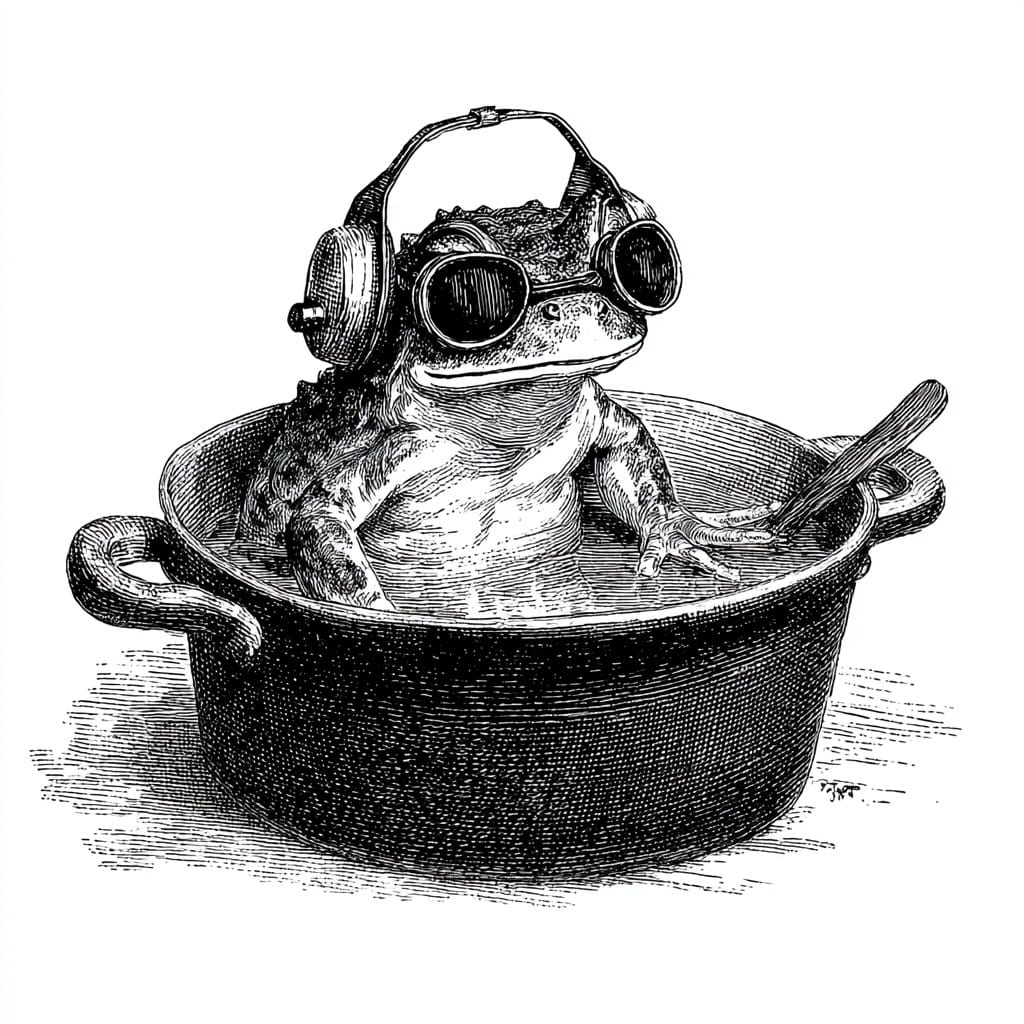
We have been using the Athanor metaphor gently. It appears in the foundational documents of this project as a description of patience: the slow, steady heat that holds conditions for transformation without engineering the outcome. The blast furnace forces; the Athanor waits. The adviser provides the vessel, but the work is the client's.
Whilst all of that is true, I have been sitting with something that the gentle version does not quite say. I want to try to say it now, partly because I think it matters for the practice, and partly because the process of working it out is itself a demonstration of the thing I am trying to describe.
The Athanor does not just hold the beginning of a process and its hopeful end. It holds what happens in the middle, and what happens in the middle, in the alchemical tradition, is nigredo: the blackening, the apparent death of the prior form, the dissolution of the material before it can reconstitute itself into something new. The alchemists were not romantic about this stage. They did not soften it or try to make it painless. Without genuine nigredo, they believed, what followed was not gold; it was gilding, a surface transformation that left the underlying structure unchanged.
I want to argue that this distinction matters more in coaching and advisory practice than we usually allow ourselves to say.
Begin with a simpler problem. There is a difference between uncertainty and ignorance that most frameworks treat as trivial, but which turns out to be fundamental.
Uncertainty, understood properly, is a condition in which outcomes are unknown but the space of possible outcomes has a shape; it has boundaries. We may not know what will happen, but we can specify what kinds of things might happen. We can build scenarios, attach distributions, and identify the variables that matter. Uncertainty is uncomfortable, but it is navigable with the right tools. We have a map, and the edges of the territory are legible, even if the path through it is not.
Ignorance is categorically different. It is not a gap within a known map. It is the condition in which the categories required to make a map do not yet exist. The territory is not unmapped; it is unrecognised. You cannot enumerate what might happen, not because the data is thin but because the vocabulary of possibility does not yet include what is about to occur. The philosopher Daniel DeNicola makes a useful distinction here: there is the ignorance we know about, the ignorance we do not know we have, and the ignorance that is constitutive of genuine uncertainty, the kind that no additional research would eliminate, because it concerns irreducibly open futures.
That third type is the one that most advisory practices quietly refuse to look at. We are trained for uncertainty. We are equipped, reasonably well, to help people navigate a space they cannot fully see. We are much less comfortable with the condition that precedes that space: one where the space itself is not yet visible, where the question cannot yet be formulated, where the most honest thing that can be said is that we do not yet know what we do not know.
The difference is not merely conceptual. It determines what a useful response looks like. Uncertainty calls for better intelligence, more careful observation, richer scenario-building. Ignorance calls for something quite different: a quality of open, receptive attention that does not impose existing categories on what is being encountered. The adviser who arrives at a situation of genuine ignorance with a taxonomy and a facilitation framework is not helping. They are, at best, moving the conversation efficiently towards a set of conclusions that the framework was always going to produce.
This is the workmanship of certainty applied to a situation that requires something else entirely.
Most of what passes for transformation in advisory and coaching work is, I believe, a form of sophisticated rearrangement. The scenario process takes what the client already knows and exposes it to new configurations. Peer groups offers productive adjacency: the friction of one person's experience against another's, and something better sometimes emerges.
None of this is without value. Rearrangement done well is genuinely useful. But there is a category of challenge for which rearrangement, however sophisticated, is not sufficient. You recognise it when you encounter it: the founder whose entire identity is built around a business model that the world is quietly rendering obsolete; the coach whose practice is organised around a theory of change that is not quite working, but whose investment in that theory makes the evidence hard to receive; and the leader whose previous success has calcified into assumptions so deeply embedded that they are no longer visible as assumptions. They have become, instead, the shape of reality itself.
For these people, a better scenario set produces a thin result. The new configuration is still drawn from the same palette. The reframe uses the same categories. Insights arrive, but they do not quite stick, because the underlying structure that generated the original difficulty remains intact. You can see this in a room when it happens. The conversation goes through all the right motions, then the meeting finishes, and three weeks later, they are back in approximately the same place, because nothing that would require their existing framework to dissolve has been allowed to enter.
The problem is not that they lack intelligence, or courage, or willingness to engage. The problem is that genuinely transformative thinking requires a prior act that looks, from the outside, like loss. Before the categories can be reconstructed, they have to be relinquished. Before the new map can form, the old one has to go dark.
This is what nigredo names.
I need to be careful here because the argument can easily become mystical in a way that is not useful. Nigredo is less a spiritual experience and more a structural description of what has to happen before genuine reconstitution is possible, and it has markers that are recognisable in practice, even if they are uncomfortable to name.
The first is that the dissolution is of frameworks rather than foundations. There is a difference between a person who is letting go of a professional or strategic identity ("I have been the person who built this kind of business, and that is no longer sufficient") and a person whose basic sense of self and stability is under threat. These are different conditions, and they require different responses. The first is productive; the second is a crisis. The advisory relationship has to be able to tell the difference and to hold the space appropriately for each.
The second is that something is still attending. Keats' negative capability, the capacity to remain in uncertainty and doubt without an irritable reaching after fact and reason, is not numbness. It is a heightened, receptive quality of awareness in which the usual structuring has become temporarily unavailable, but the person is still there, still watching, still capable of noticing what is actually in front of them. The lines are fading on the existing map, but the navigator has not disappeared.
The third, and perhaps the most important for this project, is that the Athanor is present. Dissolution that happens in isolation, without the trust, continuity and quality of attention that a sustained coaching or advisory relationship provides, is more likely to be destabilising than generative. The Athanor is not decorative; it is what makes the process safe enough to enter, and what ensures that the heat is steady rather than either too low to do any work or too high to allow the material to reconstitute.
Group work, properly facilitated, is a collective Athanor. The one-to-one coaching relationship is another. What they share is the quality of holding: the willingness to be present at the difficult middle stage, without rushing to provide a framework that would make the dissolution feel managed before it has done its work.
The argument that follows from all of this is a practical one: what does the Athanor look like when it is not a metaphor but a design brief? That is what the rest of this piece is about, and it is where I want to introduce two things we are currently building that are direct attempts to put it to work.
The advisory relationship provides the Athanor during a session. It can provide it, with more difficulty, in the days following a session when something has genuinely come undone, and the client is sitting with a question that has not yet found its form. But there is a gap in the architecture, and it is one I have become increasingly aware of in my own practice.
Most digital tools available to coaches and clients are designed for the albedo phase. They are knowledge management systems, action trackers, resource libraries: places to organise what has already been understood, to capture the insight that emerged from the conversation and give it a home where it can be retrieved and built upon. They are, in the language developed in the first part of this piece, rearrangement environments, optimised for the condition in which things are already taking shape but silent about the condition that precedes it.
What I am imagining is something designed explicitly for the boundary territory between uncertainty and ignorance: a collaborative digital space in which coaches and clients can think alongside material that is not yet ready to be organised. Not a knowledge base, nor a project management tool. A held space for the kind of thinking that exists before it knows what it is, where a half-formed question can sit alongside a relevant provocation, where an observation can be left without any pressure to turn it into an action, somewhere the coach and the client can return over days or weeks and notice what is developing without rushing it towards resolution.
The design principles follow directly from the argument. The space needs to resist closure: no completion states, no prompts to wrap up a thread or convert a reflection into a next step. It should make it easier to add a question than to answer one. It should hold rather than store: storage implies retrieval on demand, whilst holding implies a kind of sustained presence, an attentiveness to what is in the space that does not require it to arrive at a destination. It should be shared but not public, because the trust that genuine nigredo requires is not compatible with a forum or a broadcast channel.
And it should be sovereign: locally run or at minimum private and controlled, because the thinking that belongs to this space is the most genuinely exposed kind a person produces, and the conditions under which it can happen depend on knowing it remains contained.
I am aware that this is easier to describe than to build. A space that resists closure is in tension with almost every assumption that goes into the design of a digital tool. Platforms are built to produce engagement, completion, and resolution. What we envisage would have to work against that grain deliberately, and that is not a small design challenge. I am putting it here honestly, as a live question rather than a finished proposition, because I think the most useful thing I can do at this stage is to think in public about what it would require, and to invite the people reading this to think alongside me.
I want to close with something about where this thinking currently stands, because intellectual honesty about the state of one's own inquiry is part of what this project is for.
I am not yet certain that the prototype tools we are developing are the right answers to the problem I have described, but they feel like a beginning. I am confident that the problem is real: that there is a genuine gap between the quality of holding that a good coaching session provides and the tools currently available to sustain that quality in the space between. I am less certain about exactly what filling that gap requires, and I think that uncertainty is worth preserving rather than resolving prematurely.
What I am more confident about is the underlying argument: that genuine transformation requires a prior act of dissolution, and that the most important thing the Athanor Project can offer is not the insight that follows the darkness but the capacity to hold the darkness well. That is harder than it sounds in a culture that rewards confidence and completion, and in a profession built, as advisory and coaching both are, around the performance of usefulness.
The Athanor burns slowly. That is not a limitation; the slowness is not merely about patience; it is about what the steady heat is actually for: not to accelerate the process but to make it possible for the dissolution to happen at all, without the person inside it reaching prematurely for the light.
What would it mean to design a digital tool around that principle, around the idea that the most important conversations are the ones that have not yet found their form, and that the most useful thing a space can do is hold them, without resolution, for as long as they need?
That is the question we are trying to answer. I am putting it here as an invitation rather than a proposal, because the best way to develop it is in the kind of thinking-together that this project exists to enable. Bring your experience of the dark. Bring your questions about what holding actually requires. Bring your scepticism about whether a digital tool can do any of this at all.
That conversation is where the work begins.
The Athanor Project | April 2026
This piece is a stepping stone, not a conclusion. Responses and challenges are welcome.
Comments ()